Mobile Phone Price Differences Between Chinese and Global Markets
Dec 14, 2025In the global smartphone market, Chinese mobile phone brands maintain a cost-effective advantage in the domestic market through localized industrial chain integration and cost control capabilities. However, when the same models are launched in global markets, their prices generally rise significantly, forming a distinct price gap between the Chinese market and international markets. This phenomenon is not only due to the superimposition of global operational costs but also reflects the adjustment of pricing strategies by Chinese brands in overseas markets.
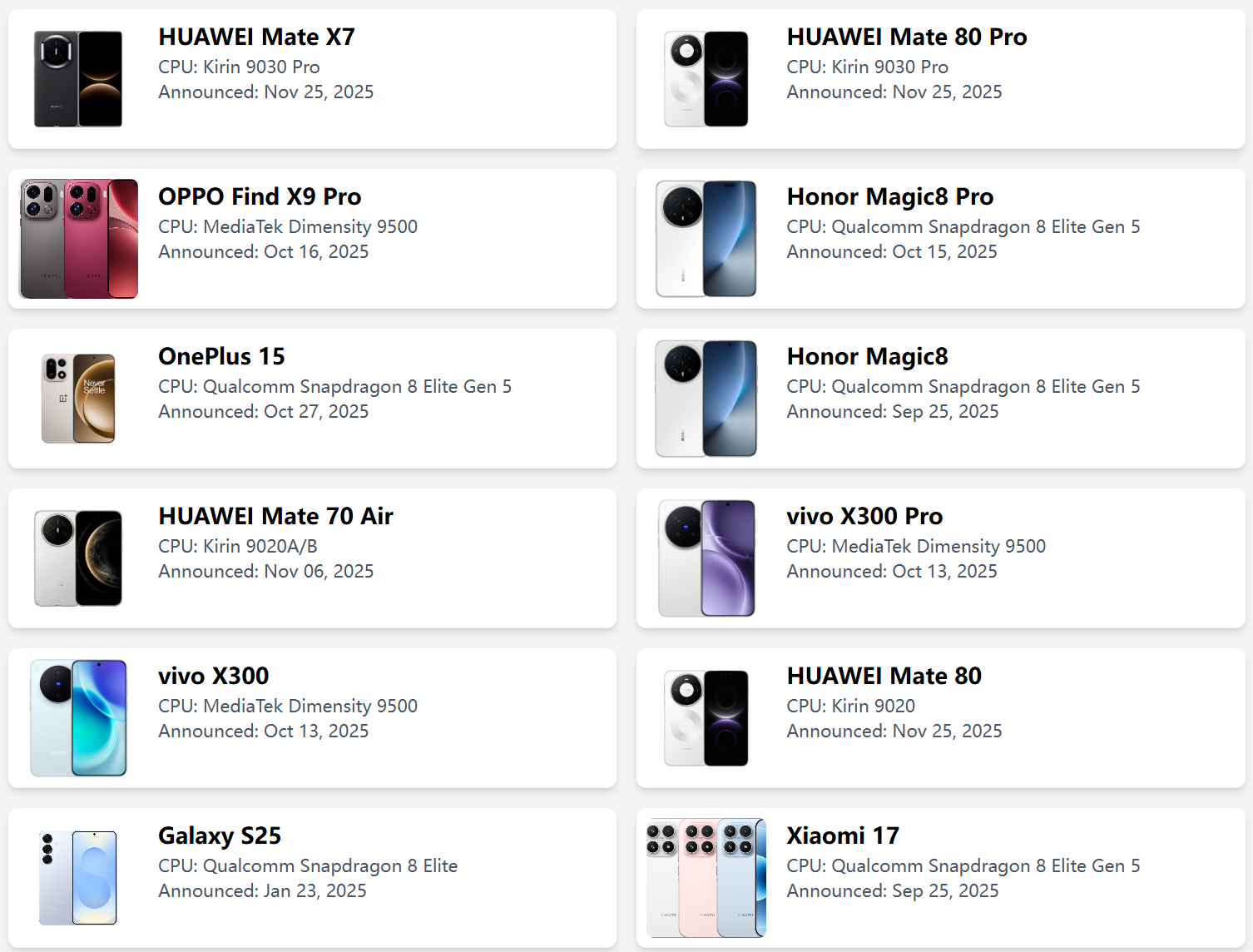
Combined with the 2025 market performance, the latest progress of eSIM technology, and the purchasing needs of global consumers, a detailed analysis is as follows:
I. Price Differences of the Same Chinese Mobile Phone Models: China vs. Global Markets
In 2025, the flagship models of mainstream Chinese mobile phone brands are significantly more expensive in global markets than in the Chinese domestic market, with a price premium generally exceeding 50% and even doubling for some models. Specific cases are as follows:
1. Xiaomi 15 Pro
- Chinese Domestic Market: The official starting price of the 16GB+512GB version is approximately US$ 685 (4,999 yuan);
- European Market: The same configuration is priced at approximately $1,259 (1,199 euros), representing a 180% premium compared to the domestic subsidized price;
- Southeast Asian Market: Priced at approximately $1,960 (69,990 baht), with a premium rate of 210%.
2. Honor Magic8 Pro
- Chinese Domestic Market: The official price of the 12GB+512GB version is approximately US$ 822 (5,999 yuan);
- Southeast Asian Market: Equivalent to approximately $1,122 (RM 4,599), with a premium rate of 31.9%.
3. Huawei Mate 70 Pro
- Chinese Domestic Market: The official price of the 12GB+256GB version is approximately $890 (6,499 yuan);
Core configuration: Kirin 9010 chip, 2K resolution LTPO OLED screen, 5,200mAh battery (88W wired + 50W wireless fast charging), satellite communication function;
- Middle Eastern Market: The same configuration is priced at $1,299, with a premium rate of 44%;
- European Market: Sold at approximately $1,049 (999 euros), a 61.6% premium over the domestic price.
II. Core Causes of Price Increases in Global Markets
The significant price increase of the same Chinese mobile phone models in global markets is essentially the result of the combined effect of global operational costs and market strategies, which can be summarized into four key factors:
1. Superimposition of Cross-Border Operational Costs
- Logistics and warehousing: Shipping/airfreight costs from domestic factories to global markets and local warehousing rental costs are 3-5 times higher than domestic distribution costs;
- Channel sharing: Service fees for mainstream overseas sales channels (such as Amazon, MediaMarkt, Carrefour) range from 15% to 25%, much higher than the 5%-10% of domestic e-commerce platforms;
- Tariffs and taxes: The EU tariff rate is 15%, while some Southeast Asian countries impose tariffs of 20%-30%. Combined with value-added tax (19%-21% in Europe), these directly drive up the terminal price.
2. Localization Adaptation and Certification Costs
- Product adaptation: Customized development is required for communication frequency bands (such as European 5G bands, North American millimeter-wave bands), charging standards (such as the EU's mandatory USB-C specification), and software ecosystems (multilingual adaptation, pre-installation of local applications) in different regions. The adaptation cost for a single model exceeds $1.37 million (10 million yuan);
- Compliance certification: Certifications such as the EU CE certification, US FCC certification, and Southeast Asian TISI certification each take 3-6 months to complete, with a single project cost exceeding $137,000 (1 million yuan), and annual renewal fees are required for maintenance.
3. Brand Marketing and Service Investment
Global consumers' awareness of Chinese brands is still lower than that of international brands, so manufacturers need to increase marketing investment: such as sponsoring sports events, launching local advertisements, and opening offline experience stores; at the same time, they need to build localized after-sales service systems (such as maintenance outlets and customer service teams). This part of the cost accounts for approximately 15%-20% of the global selling price.
4. Differentiated Pricing Strategy
Some brands use global premiums to build a high-end image and avoid "low-price involution". For example, Huawei aligns its pricing system with Samsung and Apple in the European market, conveying technical strength and brand value through premiums; Xiaomi, while maintaining cost-effectiveness, uses premiums to cover overseas operational costs and achieve profit balance.
III. Popularization Status and Global Synergistic Value of eSIM Technology
eSIM technology (embedded SIM card), with advantages such as no need for a physical card, remote activation, and multi-number switching, has become an important adaptation direction for mobile phones in global markets. Its popularization status is as follows:
1. Global Popularization Differences
- European and American markets: eSIM has been fully popularized, and flagship models of brands such as Apple and Samsung have canceled physical card slots and only support eSIM;
- Chinese market: In October 2025, the three major operators (China Mobile, China Unicom, China Telecom) simultaneously obtained the Ministry of Industry and Information Technology's approval for commercial trials of eSIM mobile phones, with services covering 31 provinces, autonomous regions, and municipalities directly under the Central Government in China. Supported models include the Huawei Mate 70 Air, OPPO Find X9 Pro (dual eSIM + dual physical card quad-card dual standby), and iPhone 17 Air (eSIM only). Xiaomi and Honor plan to launch full-series eSIM-supported models in early 2026.
2. Synergistic Value for Chinese Mobile Phones in Global Markets
eSIM technology provides multiple conveniences for Chinese mobile phones entering global markets:
- Reduce adaptation costs: There is no need to adjust hardware for SIM card specifications in different regions (such as European nano-SIM and micro-SIM in some countries); unified eSIM support can cover global markets;
- Improve user experience: Global consumers can remotely activate local operator services without replacing physical cards, meeting the needs of cross-border travel;
- More convenient compliance adaptation: Avoid regional compliance restrictions related to physical cards and simplify overseas certification processes.
3. Promotion Bottlenecks and Breakthroughs
Previously, the popularization of eSIM in China was restricted mainly due to communication security and real-name authentication requirements: the remote card writing feature of eSIM requires a sound risk control mechanism. Currently, through the phased pilot strategy of "first IoT, then consumer electronics; first wearables, then smartphones", operators have established a remote real-name authentication system and virtual number risk control system, laying the foundation for eSIM adaptation when smartphones enter global markets.
IV. Industrial Chain Support and Enhancement of Global Competitiveness
Behind the price differences of Chinese mobile phones in global markets is the strong support of the localized industrial chain:
- Upper stream: BOE and Visionox's OLED screens, CATL's battery modules, and MediaTek's customized chips reduce the cost of core components through large-scale production;
- Middle stream: Efficient OEM systems of Foxconn and BYD realize cost optimization of whole-machine production;
- Lower stream: Joint R&D between brands and suppliers (such as Xiaomi's Jinshajiang battery and Honor's Qinghai Lake battery) further compresses the cost structure.
This industrial chain advantage enables Chinese brands to maintain price competitiveness relative to international brands even after superimposing multiple costs in global markets. At the same time, with the popularization of eSIM technology and the improvement of localized operational efficiency, the premium space for Chinese mobile phones in global markets is expected to be gradually optimized, achieving the dual improvement of "cost-effectiveness + brand value".
V. Purchasing Suggestions for Global Consumers
For global consumers pursuing "high quality at a reasonable price", combined with the price differences of Chinese mobile phones and the current status of eSIM technology, the following suggestions are provided:
1. Prioritize Purchasing in China or Through Official Cross-Border Channels
- Significant price advantage: Directly purchasing models sold in the Chinese domestic market can save 50%-200% of global premiums, especially for flagship models where the price difference can reach several hundred US dollars;
- Purchasing channels: Buy through official flagship stores such as JD.com and Tmall, or brand offline direct-sale stores to ensure genuine products and complete packaging, avoiding refurbished machines and customized machines from irregular channels.
2. Focus on Verifying eSIM Support and Frequency Band Compatibility
- eSIM compatibility: If you need to use the phone in regions where eSIM is popularized (such as Europe and the United States), confirm in advance whether the model supports "global version eSIM" (some Chinese domestic models only support eSIM from domestic operators and cannot be activated overseas). It is recommended to prioritize models clearly marked with "global eSIM adaptation" such as the Huawei Mate 70 Air and OPPO Find X9 Pro;
- Communication frequency band matching: Query the mainstream 5G/4G frequency bands in the target region in advance (for example, Europe mainly uses n1/n7/n20 bands, and North America uses n2/n5/n66 bands), and select models with complete frequency band coverage to avoid signal compatibility issues.
3. Pay Attention to Warranty and After-Sales Policies
- Global warranty: Prioritize brands that provide global warranty services (such as some flagship models of Huawei and Xiaomi). Register a brand global warranty account in advance and keep the purchase invoice and packaging for overseas maintenance;
- Localized after-sales service: If there is no official brand after-sales service in your region, you can choose channels that support cross-border mail-in maintenance or purchase third-party extended warranty services.
4. Flexibly Respond to Differences in Charging Standards
Most Chinese domestic mobile phone models use Type-C interfaces (globally universal), but attention should be paid to voltage adaptation (220V in China, 110V in some overseas regions). Most new models support wide voltage (100V-240V) and can be used directly; if not, an additional voltage converter needs to be purchased.
Conclusion
The price difference of the same Chinese mobile phone models between the Chinese market and global markets is the result of the combined effect of global operational costs, brand strategies, and industrial chain advantages. The price increase in global markets is not only a reflection of cost pressure but also an inevitable path for Chinese brands to transform into high-end. For global consumers, purchasing Chinese mobile phones in China or through official cross-border channels is an excellent choice to obtain cost-effective products, but it is necessary to focus on eSIM compatibility, frequency band adaptation, and after-sales guarantee. With the full adaptation of eSIM technology and the gradual improvement of overseas supply chains, Chinese mobile phones will achieve a more balanced pricing system in the global market. In the future, the continuous innovation and global cooperation of Chinese manufacturing will continue to provide global consumers with products and services that combine cost-effectiveness and experience, further promoting the influence of Chinese mobile phone brands in the global market.
Similar Insights
- Mobile Phone Price Differences Between Chinese and Global Markets
- Android Linux: A New Professional Development Option
- vivo S50 Series Officially Launched: Fully Upgraded as the "Telephoto Live Essential"
- AI Phones: The AI Interaction Revolution and Ecological Power Game
- The Honor WIN series will be released on December 26th, and it is claimed to be the "annual esports flagship"